Accendo Reliability

Your Reliability Engineering Professional Development Site

  • Home
  • About
    • Contributors
    • About Us
    • Colophon
    • Survey
  • Reliability.fm
    • Speaking Of Reliability
    • Rooted in Reliability: The Plant Performance Podcast
    • Quality during Design
    • CMMSradio
    • Way of the Quality Warrior
    • Critical Talks
    • Asset Performance
    • Dare to Know
    • Maintenance Disrupted
    • Metal Conversations
    • The Leadership Connection
    • Practical Reliability Podcast
    • Reliability Hero
    • Reliability Matters
    • Reliability it Matters
    • Maintenance Mavericks Podcast
    • Women in Maintenance
    • Accendo Reliability Webinar Series
  • Articles
    • CRE Preparation Notes
    • NoMTBF
    • on Leadership & Career
      • Advanced Engineering Culture
      • ASQR&R
      • Engineering Leadership
      • Managing in the 2000s
      • Product Development and Process Improvement
    • on Maintenance Reliability
      • Aasan Asset Management
      • AI & Predictive Maintenance
      • Asset Management in the Mining Industry
      • CMMS and Maintenance Management
      • CMMS and Reliability
      • Conscious Asset
      • EAM & CMMS
      • Everyday RCM
      • History of Maintenance Management
      • Life Cycle Asset Management
      • Maintenance and Reliability
      • Maintenance Management
      • Plant Maintenance
      • Process Plant Reliability Engineering
      • RCM Blitz®
      • ReliabilityXperience
      • Rob’s Reliability Project
      • The Intelligent Transformer Blog
      • The People Side of Maintenance
      • The Reliability Mindset
    • on Product Reliability
      • Accelerated Reliability
      • Achieving the Benefits of Reliability
      • Apex Ridge
      • Breaking Bad for Reliability
      • Field Reliability Data Analysis
      • Metals Engineering and Product Reliability
      • Musings on Reliability and Maintenance Topics
      • Product Validation
      • Reliability by Design
      • Reliability Competence
      • Reliability Engineering Insights
      • Reliability in Emerging Technology
      • Reliability Knowledge
    • on Risk & Safety
      • CERM® Risk Insights
      • Equipment Risk and Reliability in Downhole Applications
      • Operational Risk Process Safety
    • on Systems Thinking
      • The RCA
      • Communicating with FINESSE
    • on Tools & Techniques
      • Big Data & Analytics
      • Experimental Design for NPD
      • Innovative Thinking in Reliability and Durability
      • Inside and Beyond HALT
      • Inside FMEA
      • Institute of Quality & Reliability
      • Integral Concepts
      • Learning from Failures
      • Progress in Field Reliability?
      • R for Engineering
      • Reliability Engineering Using Python
      • Reliability Reflections
      • Statistical Methods for Failure-Time Data
      • Testing 1 2 3
      • The Hardware Product Develoment Lifecycle
      • The Manufacturing Academy
  • eBooks
  • Resources
    • Special Offers
    • Accendo Authors
    • FMEA Resources
    • Glossary
    • Feed Forward Publications
    • Openings
    • Books
    • Webinar Sources
    • Journals
    • Higher Education
    • Podcasts
  • Courses
    • Your Courses
    • 14 Ways to Acquire Reliability Engineering Knowledge
    • Live Courses
      • Introduction to Reliability Engineering & Accelerated Testings Course Landing Page
      • Advanced Accelerated Testing Course Landing Page
    • Integral Concepts Courses
      • Reliability Analysis Methods Course Landing Page
      • Applied Reliability Analysis Course Landing Page
      • Statistics, Hypothesis Testing, & Regression Modeling Course Landing Page
      • Measurement System Assessment Course Landing Page
      • SPC & Process Capability Course Landing Page
      • Design of Experiments Course Landing Page
    • The Manufacturing Academy Courses
      • An Introduction to Reliability Engineering
      • Reliability Engineering Statistics
      • An Introduction to Quality Engineering
      • Quality Engineering Statistics
      • FMEA in Practice
      • Process Capability Analysis course
      • Root Cause Analysis and the 8D Corrective Action Process course
      • Return on Investment online course
    • Industrial Metallurgist Courses
    • FMEA courses Powered by The Luminous Group
      • FMEA Introduction
      • AIAG & VDA FMEA Methodology
    • Barringer Process Reliability Introduction
      • Barringer Process Reliability Introduction Course Landing Page
    • Fault Tree Analysis (FTA)
    • Foundations of RCM online course
    • Reliability Engineering for Heavy Industry
    • How to be an Online Student
    • Quondam Courses
  • Webinars
    • Upcoming Live Events
    • Accendo Reliability Webinar Series
  • Calendar
    • Call for Papers Listing
    • Upcoming Webinars
    • Webinar Calendar
  • Login
    • Member Home
Home » Articles » on Maintenance Reliability » The Reliability Crime Lab » Unlocking Plastic Deformation

by Kerina Epperly Leave a Comment

Unlocking Plastic Deformation

Unlocking Plastic Deformation

Failure Fingerprint: Plastic Deformation in Bearings

(Also known as “Brinelling,” “False Brinelling,” or “Plastic Flow” depending on cause and appearance)


Abstract: Unlike fatigue cracks or abrasive wear, plastic deformation represents a threshold failure where the material’s yield strength is exceeded, leading to permanent dimensional change. In high-precision components like bearings, even microscopic plastic flow the “failure fingerprint” can trigger catastrophic system vibration or total seizure. This article explores identifying markers of Brinelling, torsional yielding, and metallurgical slip.


Plastic Deformation: Mechanism of Failure

Plastic deformation occurs when mechanical stress exceeds the elastic limit of the alloy. For standard AISI 52100 bearing steel, this yield point typically hovers around 1,500–1,800 MPa. Once reached, dislocations within the crystalline lattice move permanently along slip planes. In bearings, this is often localized (hertzian contact stress), while in shafts, it is frequently a bulk phenomenon (torque overloads).
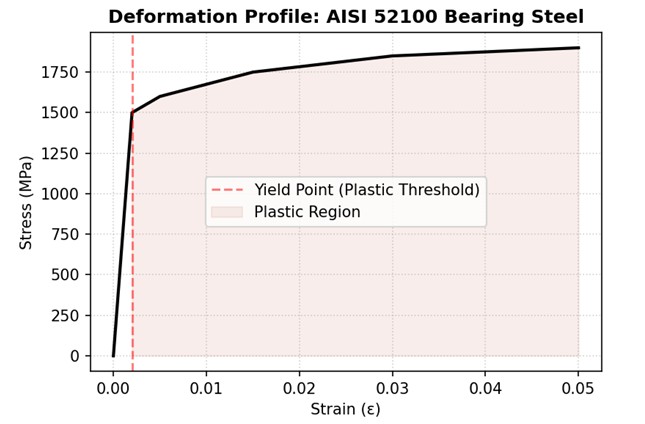
Stress-strain curve illustrating the transition from elastic recovery to permanent plastic flow in hardened
components.

Bearing Failure Fingerprint

True Brinelling

True Brinelling is characterized by permanent indentations in the raceways. The fingerprint is distinct: the indentations often retain the original grinding marks of the manufacturing process at the bottom of the crater. This indicates the material was pushed aside by static overload (e.g., a heavy impact or improper mounting) rather than worn away by friction.

Fingerprints:

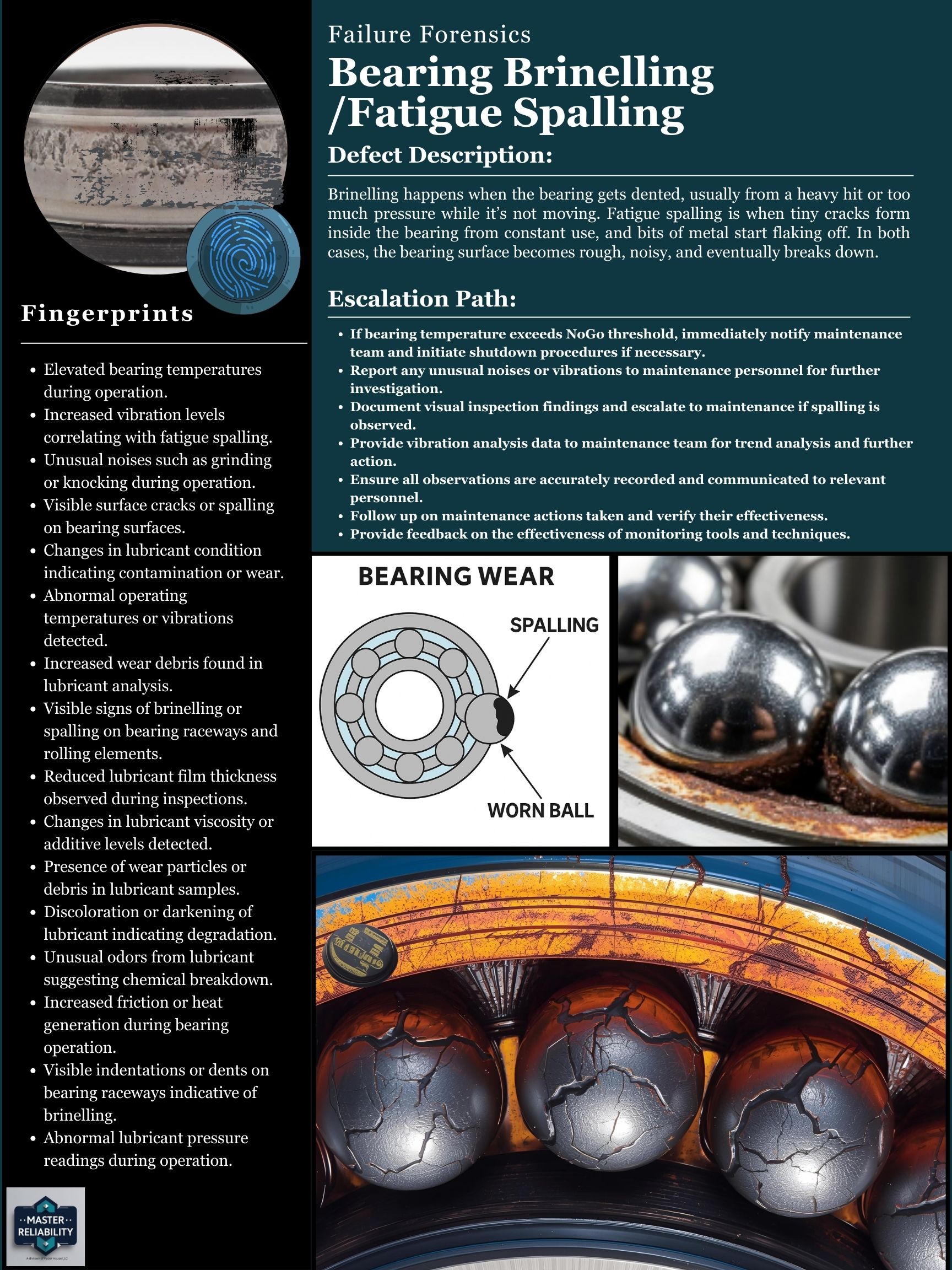
  • Elevated bearing temperatures
  • Increased vibration
  • Unusual noises
  • Visible surface indentation, cracking, pits
  • Lubrication contamination from particulates
  • Change in lubrication viscosity
Bearing Brinelling / Fatigue Spalling Failure Forensic Detection Sheet

Key Diagnostic: If the indentation shows a “lip” or raised edge of displaced metal, it is confirmed plastic flow. If the metal is smooth or polished, it is likely “False Brinelling” caused by vibration.


False Brinelling

False Brinelling is often confused with plastic deformation, this is actually a wear phenomenon. However, long-term false brinelling can lead to “fretting,” which eventually weakens the surface and lowers the threshold for actual plastic yielding under lower loads.

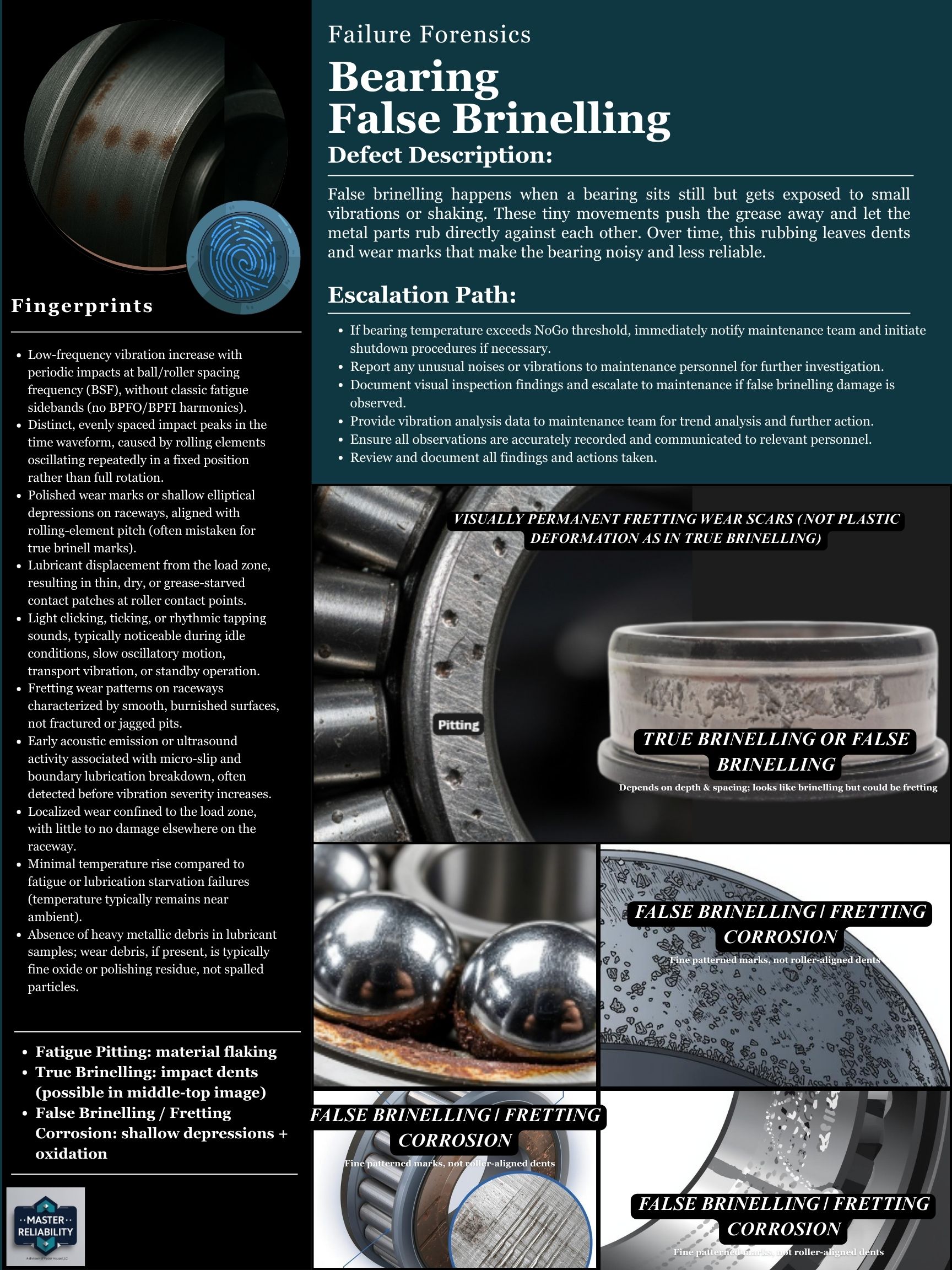
Fingerprints

  • Polished wear marks or shallow elliptical depressions on raceways
  • Lubricant displacement from the load zone
  • Light clicking, ticking, or rhythmic tapping sounds
  • Fretting wear patterns on raceways
Bearing False Brinelling Failure Forensic Detection Sheet

True brinelling is characterized by permanent impact indentations caused by plastic deformation of the bearing surfaces. This damage produces wear particles that are carried away by the lubricant, contributing to lubricant contamination. In contrast, false brinelling occurs when vibration or small oscillatory motion displaces lubricant from the raceway contact zone, leading to localized lubricant starvation rather than material displacement from heavy loading. Put simply, excessive or improper loading tends to create surface damage that sheds debris into the lubricant, while vibration without adequate rotation primarily leads to lubricant loss at the contact points.


Fingerprints of Bearing Plastic Deformation

AI image illustrating Plastic Deformation.

Above is an AI image illustrating Plastic Deformation.

CategoryDescription
Surface AppearanceLocalized dents or depressions in raceways and/or rolling elements; evenly spaced around the circumference corresponding to rolling element pitch. In severe cases, flattened spots or smeared surfaces.
TexturePolished or mirror-like in advanced cases; sometimes with raised edges or microcracks at dent boundaries.
LocationTypically, on load zone of stationary race; in false brinelling, marks may occur 180° apart, matching vibration frequency.
Lubrication CluesDiscolored or contaminated grease from metallic wear debris; metallic “sparkle” under light.
ProgressionInitially cosmetic, but the dents cause high stress concentrations leading to early spalling or fatigue pitting.
Fingerprints of Plastic Deformation in Bearings

Failure Progression

End-of-life may be predicted for a bearing experiencing plastic deformation by matching the current state of the bearing to the failure stage. Operators may be trained to look for these fingerprints during their normal inspections and report out when a deviation has occurred. In TPM, operator’s fill out a defect card when a defect is detected.

StageDescription
0 – StableNo visible defects; normal contact stress.
1 – Yield InitiationLocal stress exceeds yield strength; micro-indentations begin.
2 – Surface FlowDents form under stationary rolling elements; surface microcracks appear.
3 – Plastic Flow ExpansionDents deepen, raised edges increase stress; lubricant contamination begins.
4 – Secondary FatigueMicrocracks propagate from dents → pitting/spalling.
5 – Functional FailureBearing roughness severe; high temperature, noise, and vibration.
Failure Progression of Bearing Plastic Deformation

Note: Typically, Operators are able to begin detecting any deviation from the norm in stages 3 and 4 of failure progression lifecycle.


5-Sense Diagnostics

SenseObservable Fingerprint
Sight 👁️Dents on raceways, mirror-like spots, debris sparkle in grease.
Sound 👂Rhythmic ticking or rumbling under load.
Touch ✋Resistance when hand-rotating the bearing; “notchy” feel.
Smell 👃Burnt or metallic odor if lubricant overheats.
Temperature 🌡️Localized heat at the raceway zone under deformation.
5-Sense Detection of Bearing Plastic Deformation

Root Causes of Bearing Plastic Deformation

  • Excessive static or dynamic load beyond yield strength of the bearing material.
  • Shock loading during installation or operation.
  • Vibration under static load without rotation (false brinelling).
  • Improper mounting (hammer blows, press misalignment).
  • Inadequate internal clearance or tight fits causing over-stress.
  • Home
  • About
    • Contributors
    • About Us
    • Colophon
    • Survey
  • Reliability.fm
    • Speaking Of Reliability
    • Rooted in Reliability: The Plant Performance Podcast
    • Quality during Design
    • CMMSradioGreg Christensen’s podcast CMMSradio
    • Way of the Quality WarriorKeith Fong’s Way of the Quality Warrior podcast show
    • Critical TalksPodcast by Gabor Szabo titled Critical Talks on quality topics
    • Asset Performancepodcast hosted by Wim VC
    • Dare to Know
    • Maintenance Disrupted
    • Metal ConversationsPodcast by Michael Pfeifer
    • The Leadership Connection
    • Practical Reliability Podcast
    • Reliability Matters
    • Reliability it MattersPodcast by Akshay Athalye
    • Maintenance Mavericks Podcast
    • Women in MaintenancePodcast by Caitlyn Young-Gilbert
    • Accendo Reliability Webinar Series
  • Articles
    • CRE Preparation Notes
    • NoMTBFThe set of articles on NoMTBF and related topics
    • on Leadership u0026amp; Career
      • Advanced Engineering Culture
      • ASQRu0026amp;RArticle series by John Martz and Jim Liddy
      • Engineering Leadership
      • Managing in the 2000s
      • Product Development and Process Improvement
    • on Maintenance Reliability
      • Aasan Asset Management
      • AI u0026amp; Predictive MaintenanceArun Gowtham’s articles series
      • Asset Management in the Mining Industry
      • CMMS and Maintenance ManagementLindsay Walker of Nexgen article series
      • CMMS and Reliability
      • Conscious Asset
      • EAM u0026amp; CMMS
      • Everyday RCM
      • History of Maintenance ManagementKarl Burnett’s article sereis
      • Life Cycle Asset ManagementMike Sondalini’s article series Life Cycle Asset Management
      • Maintenance and Reliability
      • Maintenance ManagementMike Sondalini’s article series Maintenance Management
      • Plant Maintenance
      • Process Plant Reliability EngineeringAndrew Kelleher’s article series RAMS Mentat
      • RCM Blitzu003csupu003e®u003c/supu003e
      • ReliabilityXperience
      • Rob’s Reliability Project
      • The Intelligent Transformer Blog
      • The People Side of MaintenanceTor’s article series
      • The Reliability MindsetAndré-Michel Ferrari’s The Reliability Mindset article series
    • on Product Reliability
      • Accelerated Reliability
      • Achieving the Benefits of Reliability
      • Apex Ridge
      • Field Reliability Data AnalysisDebasmita Mukherjee’s article series
      • Metals Engineering and Product ReliabilityThe topics should be of interest to product design engineers. I’ll write about topics related to the metals engineering perspective to component design and metallurgical aspects of component reliability.
      • Musings on Reliability and Maintenance TopicsShort essays and thoughts (musings) on reliability and maintenance engineering topics. ISSN 2329-0080
      • Product Validation
      • Reliability CompetenceEnrico Belmonte’s article series
      • Reliability Engineering Insights
      • Reliability in Emerging Technology
      • Reliability KnowledgeSemion Gengrinovich’s article series
    • on Risk u0026amp; Safety
      • CERM® Risk Insights
      • Equipment Risk and Reliability in Downhole Applications
      • Operational Risk Process SafetyArticle series category for Sanjeev Saraf’s series
    • on Systems Thinking
      • Communicating with FINESSEarticle series by JD Solomon
      • The RCA
    • on Tools u0026amp; Techniques
      • Big Data u0026amp; Analytics
      • Experimental Design for NPD
      • Innovative Thinking in Reliability and Durability
      • Inside and Beyond HALT
      • Inside FMEA
      • Institute of Quality u0026amp; ReliabilityHemant’s IQR article series
      • Integral Concepts
      • Learning from Failures
      • Progress in Field Reliability?
      • R for EngineeringAn article series by Gabor Szabo
      • Reliability Engineering Using Python
      • Reliability Reflections
      • Statistical Methods for Failure-Time DataArticle series by Shishir Rao titled Statistical Methods for Failure-Time Data
      • Testing 1 2 3
      • The Manufacturing Academy
  • eBooks
  • Resources
    • Accendo Authors
    • FMEA Resources
    • Glossary
    • Feed Forward Publications
    • Openings
    • Books
    • Webinar Sources
    • Journals
    • Higher Education
    • Podcasts
  • Courses
    • Your Courses
    • 14 Ways to Acquire Reliability Engineering Knowledge
    • Live Courses
      • Introduction to Reliability Engineering u0026#038; Accelerated Testings Course Landing Page
      • Advanced Accelerated Testing Course Landing Page
    • Integral Concepts Courses
      • Reliability Analysis Methods Course Landing Page
      • Applied Reliability Analysis Course Landing Page
      • Statistics, Hypothesis Testing, u0026#038; Regression Modeling Course Landing Page
      • Measurement System Assessment Course Landing Page
      • SPC u0026#038; Process Capability Course Landing Page
      • Design of Experiments Course Landing Page
    • The Manufacturing Academy Courses
      • An Introduction to Reliability Engineering
      • Reliability Engineering Statistics
      • An Introduction to Quality Engineering
      • Quality Engineering Statistics
      • FMEA in Practice
      • Process Capability Analysis course
      • Root Cause Analysis and the 8D Corrective Action Process course
      • Return on Investment online course
    • Industrial Metallurgist Courses
    • FMEA courses Powered by The Luminous Group
      • FMEA Introduction
      • AIAG u0026#038; VDA FMEA Methodology
    • Foundations of RCM online course
    • Fault Tree Analysis (FTA)
    • Reliability Engineering for Heavy Industry
    • How to be an Online Student
    • Quondam Courses
  • Webinars
    • Upcoming Live Events
    • Accendo Reliability Webinar Series
  • Calendar
    • Call for Papers Listing
    • Upcoming Webinars
    • Webinar Calendar
  • Login
    • Member Home

Prevention & Detection

Detecting plastic deformation before a breach occurs requires precision monitoring. Vibration Analysis in bearings can catch the rhythmic pulse of a brinell mark long before the bearing “feels” rough to a manual check. In shafts, Laser Alignment and run-out sensors are the primary tools for identifying permanent bends. To prevent these signatures, design safety factors must account for “Shock Loads.” A bearing rated for 10kN service can fail instantaneously if a 30kN surge occurs for even 5ms, as the hertzian contact area is tiny, causing local pressure to skyrocket past the yield limit.


Conclusion

Plastic deformation is a permanent record of an event that exceeded the component’s design limits. By examining the topography of indentations in bearings forensic engineers can reconstruct the magnitude and direction of the failure-inducing force. Distinguishing between wear (material loss) and plastic flow (material displacement) is the fundamental step in any root cause analysis.

Once the root cause is identified, corrective and preventative measures may be put in place to eliminate future occurrences of bearing plastic deformation.


Further Reading:


ISO 15243: Rolling bearings — Damage and failures.
ASM Handbook, Vol 11: Failure Analysis and Prevention.


Join us on our YouTube channel for the free lecture: Thermal Expansion & Shaft Failure — Explained! 🔥 LS-005


Edit Post “Decoding Early Thermal Stress in Rotating Equipment” ‹ Accendo Reliability — Rainmaker Platform

Filed Under: Articles, on Maintenance Reliability, The Reliability Crime Lab

About Kerina Epperly

Kerina Epperly is a Failure Forensic Specialist, RCM2, TPM transformation leader, and the creator of FRAME-D an advanced diagnostic command center that makes reliability visual, simple, and teachable. With over 25 years of cross-industry experience, she brings a practical, investigative approach to solving equipment failures and elevating maintenance culture.

« Why Reliability Engineers Should Embrace Monte Carlo Analysis

Leave a Reply Cancel reply

Your email address will not be published. Required fields are marked *

The Reliability Crime Lab article series logo Photo of Kerina EpperlyArticles by Kerina Kepperly
in the The Reliability Crime Lab article series

Recent Posts

  • Unlocking Plastic Deformation
  • Why Reliability Engineers Should Embrace Monte Carlo Analysis
  • MTBF Search Result Sadness
  • Test Failure During Validation – Is it Disaster or Blessing?
  • How to Create a Positive Risk Culture
[show_to accesslevel="Free" ] Thanks for being a member [member_first_name]! [/show_to][hide_from visible_to='public']

Join Accendo

Receive information and updates about articles and many other resources offered by Accendo Reliability by becoming a member. It’s free and only takes a minute.

Join Today

[/hide_from]

© 2026 FMS Reliability · Privacy Policy · Terms of Service · Cookies Policy

Book the Course with John
  Ask a question or send along a comment. Please login to view and use the contact form.
This site uses cookies to give you a better experience, analyze site traffic, and gain insight to products or offers that may interest you. By continuing, you consent to the use of cookies. Learn how we use cookies, how they work, and how to set your browser preferences by reading our Cookies Policy.