
Accendo Reliability

Your Reliability Engineering Professional Development Site

  • Home
  • About
    • Contributors
    • About Us
    • Colophon
    • Survey
  • Reliability.fm
    • Speaking Of Reliability
    • Rooted in Reliability: The Plant Performance Podcast
    • Quality during Design
    • CMMSradio
    • Way of the Quality Warrior
    • Critical Talks
    • Asset Performance
    • Dare to Know
    • Maintenance Disrupted
    • Metal Conversations
    • The Leadership Connection
    • Practical Reliability Podcast
    • Reliability Hero
    • Reliability Matters
    • Reliability it Matters
    • Maintenance Mavericks Podcast
    • Women in Maintenance
    • Accendo Reliability Webinar Series
  • Articles
    • CRE Preparation Notes
    • NoMTBF
    • on Leadership & Career
      • Advanced Engineering Culture
      • ASQR&R
      • Engineering Leadership
      • Managing in the 2000s
      • Product Development and Process Improvement
    • on Maintenance Reliability
      • Aasan Asset Management
      • AI & Predictive Maintenance
      • Asset Management in the Mining Industry
      • CMMS and Maintenance Management
      • CMMS and Reliability
      • Conscious Asset
      • EAM & CMMS
      • Everyday RCM
      • History of Maintenance Management
      • Life Cycle Asset Management
      • Maintenance and Reliability
      • Maintenance Management
      • Plant Maintenance
      • Process Plant Reliability Engineering
      • RCM Blitz®
      • ReliabilityXperience
      • Rob’s Reliability Project
      • The Intelligent Transformer Blog
      • The People Side of Maintenance
      • The Reliability Mindset
    • on Product Reliability
      • Accelerated Reliability
      • Achieving the Benefits of Reliability
      • Apex Ridge
      • Breaking Bad for Reliability
      • Field Reliability Data Analysis
      • Metals Engineering and Product Reliability
      • Musings on Reliability and Maintenance Topics
      • Product Validation
      • Reliability by Design
      • Reliability Competence
      • Reliability Engineering Insights
      • Reliability in Emerging Technology
      • Reliability Knowledge
    • on Risk & Safety
      • CERM® Risk Insights
      • Equipment Risk and Reliability in Downhole Applications
      • Operational Risk Process Safety
    • on Systems Thinking
      • The RCA
      • Communicating with FINESSE
    • on Tools & Techniques
      • Big Data & Analytics
      • Experimental Design for NPD
      • Innovative Thinking in Reliability and Durability
      • Inside and Beyond HALT
      • Inside FMEA
      • Institute of Quality & Reliability
      • Integral Concepts
      • Learning from Failures
      • Progress in Field Reliability?
      • R for Engineering
      • Reliability Engineering Using Python
      • Reliability Reflections
      • Statistical Methods for Failure-Time Data
      • Testing 1 2 3
      • The Hardware Product Develoment Lifecycle
      • The Manufacturing Academy
  • eBooks
  • Resources
    • Special Offers
    • Accendo Authors
    • FMEA Resources
    • Glossary
    • Feed Forward Publications
    • Openings
    • Books
    • Webinar Sources
    • Journals
    • Higher Education
    • Podcasts
  • Courses
    • Your Courses
    • 14 Ways to Acquire Reliability Engineering Knowledge
    • Live Courses
      • Introduction to Reliability Engineering & Accelerated Testings Course Landing Page
      • Advanced Accelerated Testing Course Landing Page
    • Integral Concepts Courses
      • Reliability Analysis Methods Course Landing Page
      • Applied Reliability Analysis Course Landing Page
      • Statistics, Hypothesis Testing, & Regression Modeling Course Landing Page
      • Measurement System Assessment Course Landing Page
      • SPC & Process Capability Course Landing Page
      • Design of Experiments Course Landing Page
    • The Manufacturing Academy Courses
      • An Introduction to Reliability Engineering
      • Reliability Engineering Statistics
      • An Introduction to Quality Engineering
      • Quality Engineering Statistics
      • FMEA in Practice
      • Process Capability Analysis course
      • Root Cause Analysis and the 8D Corrective Action Process course
      • Return on Investment online course
    • Industrial Metallurgist Courses
    • FMEA courses Powered by The Luminous Group
      • FMEA Introduction
      • AIAG & VDA FMEA Methodology
    • Barringer Process Reliability Introduction
      • Barringer Process Reliability Introduction Course Landing Page
    • Fault Tree Analysis (FTA)
    • Foundations of RCM online course
    • Reliability Engineering for Heavy Industry
    • How to be an Online Student
    • Quondam Courses
  • Webinars
    • Upcoming Live Events
    • Accendo Reliability Webinar Series
  • Calendar
    • Call for Papers Listing
    • Upcoming Webinars
    • Webinar Calendar
  • Login
    • Member Home
Home » Articles » on Maintenance Reliability » The Reliability Crime Lab » Decoding Early Thermal Stress in Rotating Equipment

by Kerina Epperly Leave a Comment

Decoding Early Thermal Stress in Rotating Equipment

Decoding Early Thermal Stress in Rotating Equipment

Visual Inspections That Reveal Early Thermal Stress Damage

Thermal stress in components leads to premature failure. In the high-stakes world of industrial maintenance, the most dangerous failures are those that develop in silence. Thermally induced shaft damage typically does not announce itself with a sudden snap; rather, it matures through a progression of temperature gradients, mechanical constraints, and repeated thermal cycling. By the time cracks or permanent deformation become visible to the untrained eye, the window for low-cost intervention has usually closed.

Visual inspection and thermal imaging are both excellent non-destructive testing (NDT) techniques that detect impending failures early. In this article, we will discuss what to look for, what it means, and potential counter measures.


“Training site personnel to look for early indicators of thermal stress damage on shafts, couplings, and bearings is the single most effective way to prevent premature breakdown.”


The Genesis of Thermal Stress

Thermal stress in rotating machinery is rarely an isolated phenomenon. It is fundamentally an energy conversion problem. When
mechanical systems operate outside their design specifications due to misalignment, improper lubrication, or loading imbalances the kinetic energy that should be driving production is instead converted into waste heat.

The earliest stages of thermal stress are often invisible to the naked eye and undetectable by basic touch-tests. At the molecular level,
excessive heat begins to degrade the viscosity of lubricants, leading to a feedback loop where increased friction generates even more heat.


The 10°C Rule: In many electrical and mechanical insulation systems, every 10°C increase in operating temperature above
the rated limit can effectively halve the component’s remaining useful life (RUL).


Identifying the Early Signatures of Thermal Stress

Modern predictive maintenance (PdM) relies on identifying the “inflection point” the moment when a component transitions from steady-state operation to an accelerated wear phase. Thermal signatures provide one of the most reliable indicators of this transition.
High-definition infrared thermography (IRT) allows technicians to visualize heat distribution across a bearing housing or motor
casing. An asymmetrical heat pattern often points to angular misalignment, whereas a uniform but elevated temperature profile
might suggest over-greasing or internal clearance issues.
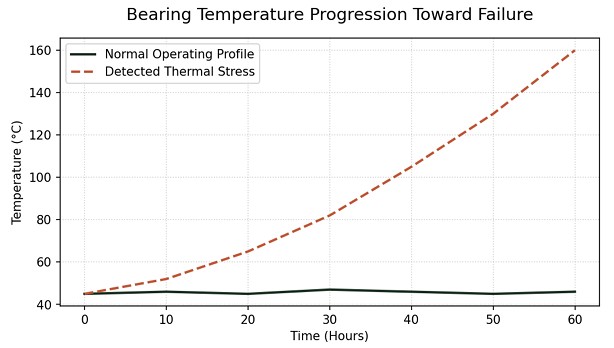
A Bearing Failure Map showing the exponential failure rate of a bearing under stress / fatigue/
Comparison between normal operating temperatures and the exponential climb associated with
thermal stress leading to bearing seizure.

Heat History Stamp: Heat Discoloration/Oxide Tinting

Heat discoloration / oxide tinting on shafts (and nearby nuts, washers, coupling hubs, keys, etc.) is a heat-history stamp. It forms when metal oxidizes after exposure to elevated temperature in the presence of oxygen. Once the oxide film is present, moisture accelerates corrosion; rust forms faster and adheres more aggressively. Tinting is therefore not cosmetic; it is evidence of a thermal event and a future corrosion risk.

Go to the Gemba:

Operators and technicians should be trained to identify failure fingerprints, escalate the issue when identified, and implement remediation procedures. During routine inspections, look for the following visual indicators of thermal stress.

Key Visual Indicators of Thermal Stress

  • Heat discoloration or oxide tinting on shafts and nearby hardware
  • Polished rub marks indicating transient bowing during operation
  • Seal hardening, cracking, or glazing from elevated temperatures
  • Uneven wear patterns on bearings and conveyor components
  • Belt tracking drift that worsens at operating temperature

Color pattern is the clue:

Key Color indicators include:

Observed ColorInterpretation
Straw / light gold tintMild overheating exposure; initial oxidation phase
Brown / purpleModerate overheating; potential for lubricant
degradation
Blue / deep blueSignificant overheating; serious thermal event
requiring investigation
Patchy / one-sided tintLocalized hot spot (misalignment, rub, slip)
Tinting plus black soot / charSevere heating or lubricant burning
Color Observation and Associated Potential Issue

When to inspect immediately after reaching steady-state temperature, and again during cool-down (thermal contraction phase).


Where to focus shaft shoulders, bearing fits, seal lands, coupling hubs, keyways, and near heat sources (ovens/furnaces).


Note: Exact oxide colors vary with material, surface finish, and duration of exposure; use color primarily as a relative severity indicator.


Rule of thumb: If tinting is present, temperatures were high enough to change surface chemistry and may have altered lubrication performance, fits, or hardness locally.


Common Causes of Thermal Stress
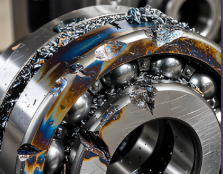
A bearing displaying significant signs of thermal damage with classic bluing / rainbow signature.
  1. Overheating from Friction: Bearing running hot (lack of lubrication, wrong viscosity, over-greasing), tight/dry seal installation, or shaft rubbing on guards/housings.
  2. Electrical Damage: Tinting combined with fluting or pitting on bearing races can indicate shaft current discharge (often VFD-related).
  3. Thermal Gradients: Localized tinting can signal misalignment, thermal bow, or uneven cooling/heating cycles.
  4. Overload / Sustained Torque: Slip and micro-motion at the coupling hub or keyway region.

Confirmation of Potential Thermal Stress:

During investigation, evaluate the shaft and supporting components with the following questions in mind:

  1. Where exactly is the tinting? (bearing seat? seal land? coupling hub?)
  2. Does the thermal image show an image of a uniform thermal gradient or localized hot spots?
  3. Are there matching signs of friction (smearing/fretting) or electrical discharge (EDM marks/fluting)?

Quick Confirmation Checklist

  • Temperature: compare IR readings across bearing housings, shaft ends, and coupling hubs at steady state.
  • Fit / movement: check for fretting debris at hub/shaft interface and measure runout.
  • Lubrication condition: inspect grease for darkening, bleeding oil, varnish smell, or hard crusting.
  • Electrical: look for EDM frosting/fluting patterns; verify VFD grounding and shaft grounding path.

Thermal Stress Typically Correlates with (Failure Fingerprints)

If you see oxide tinting, it often pairs with:

  • Blueing at bearing seat (inner race creep / loose fit)
  • Smearing / galling at shaft seat
  • Fretting corrosion (reddish/brown powder)
  • Seal lip wear or melted seal material
  • Coupling hub bore discoloration

Identifying Thermal Stress at Onset Using Acoustic and Thermal Correlation

When early detection is paramount, such as the case with critical A-class components, ultrasonic emission testing should be implemented as part of the PM strategy. While temperature is the symptom, ultrasonic emissions are often the precursor. Early friction creates high-frequency sound waves long before the mass of the metal housing warms up enough to be detected by external sensors.


Conclusion

Thermal stress is a silent killer of components compromising their structural integrity and lifetime. When operators and technicians are trained to identify failure fingerprints, escalate the issue when identified, and implement remediation procedures components have a higher probability of maximizing their RUL.


  • SOR 1004 Confirmation Bias with HALT
  • Taking on Unnecessary Project Risk
  • SOR 1029 Thermal HALT
  • Non-destructive Testing of Welds
  • Find Me the Statistics that I Like to Believe the Most …

Join us on our YouTube channel for the free lecture: Thermal Expansion & Shaft Failure — Explained! 🔥 LS-005


Next Article: Temperature mapping & thermal imaging interpretation

Filed Under: Articles, on Maintenance Reliability, The Reliability Crime Lab

About Kerina Epperly

Kerina Epperly is a Failure Forensic Specialist, RCM2, TPM transformation leader, and the creator of FRAME-D an advanced diagnostic command center that makes reliability visual, simple, and teachable. With over 25 years of cross-industry experience, she brings a practical, investigative approach to solving equipment failures and elevating maintenance culture.

« Why Reliability Engineers Should Beware of Monte Carlo Analysis

Leave a Reply Cancel reply

Your email address will not be published. Required fields are marked *

The Reliability Crime Lab article series logo Photo of Kerina EpperlyArticles by Kerina Kepperly
in the The Reliability Crime Lab article series

Recent Posts

  • Decoding Early Thermal Stress in Rotating Equipment
  • Why Reliability Engineers Should Beware of Monte Carlo Analysis
  • 4 Questions to Ask When Confronted with MTBF
  • Historical Data
  • Project: Intelligent Disobedience — Uncommon Sense
[show_to accesslevel="Free" ] Thanks for being a member [member_first_name]! [/show_to][hide_from visible_to='public']

Join Accendo

Receive information and updates about articles and many other resources offered by Accendo Reliability by becoming a member. It’s free and only takes a minute.

Join Today

[/hide_from]

© 2026 FMS Reliability · Privacy Policy · Terms of Service · Cookies Policy

Book the Course with John
  Ask a question or send along a comment. Please login to view and use the contact form.
This site uses cookies to give you a better experience, analyze site traffic, and gain insight to products or offers that may interest you. By continuing, you consent to the use of cookies. Learn how we use cookies, how they work, and how to set your browser preferences by reading our Cookies Policy.