Accendo Reliability

Your Reliability Engineering Professional Development Site

  • Home
  • About
    • Contributors
    • About Us
    • Colophon
    • Survey
  • Reliability.fm
    • Speaking Of Reliability
    • Rooted in Reliability: The Plant Performance Podcast
    • Quality during Design
    • CMMSradio
    • Way of the Quality Warrior
    • Critical Talks
    • Asset Performance
    • Dare to Know
    • Maintenance Disrupted
    • Metal Conversations
    • The Leadership Connection
    • Practical Reliability Podcast
    • Reliability Hero
    • Reliability Matters
    • Reliability it Matters
    • Maintenance Mavericks Podcast
    • Women in Maintenance
    • Accendo Reliability Webinar Series
  • Articles
    • CRE Preparation Notes
    • NoMTBF
    • on Leadership & Career
      • Advanced Engineering Culture
      • ASQR&R
      • Engineering Leadership
      • Managing in the 2000s
      • Product Development and Process Improvement
    • on Maintenance Reliability
      • Aasan Asset Management
      • AI & Predictive Maintenance
      • Asset Management in the Mining Industry
      • CMMS and Maintenance Management
      • CMMS and Reliability
      • Conscious Asset
      • EAM & CMMS
      • Everyday RCM
      • History of Maintenance Management
      • Life Cycle Asset Management
      • Maintenance and Reliability
      • Maintenance Management
      • Plant Maintenance
      • Process Plant Reliability Engineering
      • RCM Blitz®
      • ReliabilityXperience
      • Rob’s Reliability Project
      • The Intelligent Transformer Blog
      • The People Side of Maintenance
      • The Reliability Mindset
    • on Product Reliability
      • Accelerated Reliability
      • Achieving the Benefits of Reliability
      • Apex Ridge
      • Breaking Bad for Reliability
      • Field Reliability Data Analysis
      • Metals Engineering and Product Reliability
      • Musings on Reliability and Maintenance Topics
      • Product Validation
      • Reliability by Design
      • Reliability Competence
      • Reliability Engineering Insights
      • Reliability in Emerging Technology
      • Reliability Knowledge
    • on Risk & Safety
      • CERM® Risk Insights
      • Equipment Risk and Reliability in Downhole Applications
      • Operational Risk Process Safety
    • on Systems Thinking
      • The RCA
      • Communicating with FINESSE
    • on Tools & Techniques
      • Big Data & Analytics
      • Experimental Design for NPD
      • Innovative Thinking in Reliability and Durability
      • Inside and Beyond HALT
      • Inside FMEA
      • Institute of Quality & Reliability
      • Integral Concepts
      • Learning from Failures
      • Progress in Field Reliability?
      • R for Engineering
      • Reliability Engineering Using Python
      • Reliability Reflections
      • Statistical Methods for Failure-Time Data
      • Testing 1 2 3
      • The Hardware Product Develoment Lifecycle
      • The Manufacturing Academy
  • eBooks
  • Resources
    • Special Offers
    • Accendo Authors
    • FMEA Resources
    • Glossary
    • Feed Forward Publications
    • Openings
    • Books
    • Webinar Sources
    • Journals
    • Higher Education
    • Podcasts
  • Courses
    • Your Courses
    • 14 Ways to Acquire Reliability Engineering Knowledge
    • Live Courses
      • Introduction to Reliability Engineering & Accelerated Testings Course Landing Page
      • Advanced Accelerated Testing Course Landing Page
    • Integral Concepts Courses
      • Reliability Analysis Methods Course Landing Page
      • Applied Reliability Analysis Course Landing Page
      • Statistics, Hypothesis Testing, & Regression Modeling Course Landing Page
      • Measurement System Assessment Course Landing Page
      • SPC & Process Capability Course Landing Page
      • Design of Experiments Course Landing Page
    • The Manufacturing Academy Courses
      • An Introduction to Reliability Engineering
      • Reliability Engineering Statistics
      • An Introduction to Quality Engineering
      • Quality Engineering Statistics
      • FMEA in Practice
      • Process Capability Analysis course
      • Root Cause Analysis and the 8D Corrective Action Process course
      • Return on Investment online course
    • Industrial Metallurgist Courses
    • FMEA courses Powered by The Luminous Group
      • FMEA Introduction
      • AIAG & VDA FMEA Methodology
    • Barringer Process Reliability Introduction
      • Barringer Process Reliability Introduction Course Landing Page
    • Fault Tree Analysis (FTA)
    • Foundations of RCM online course
    • Reliability Engineering for Heavy Industry
    • How to be an Online Student
    • Quondam Courses
  • Webinars
    • Upcoming Live Events
    • Accendo Reliability Webinar Series
  • Calendar
    • Call for Papers Listing
    • Upcoming Webinars
    • Webinar Calendar
  • Login
    • Member Home
Home » LMS » 14 Ways to Acquire Reliability Engineering Knowledge » Experiment

by Fred Schenkelberg

Experiment

Lesson 6 of 14 Ways to Acquire
Reliability Engineering Knowledge
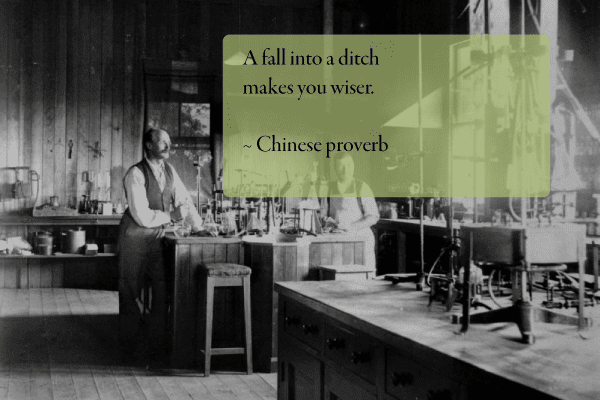
14 Ways lesson 6 image, Chemistry laboratory, probably at Gatton Agricultural College, Queensland. Courtesy of State Library of Queensland, and quote by Chinese proverb, "A fall into a ditch makes you wiser."
Chemistry laboratory, probably at Gatton Agricultural College, Queensland. Courtesy of State Library of Queensland

[show_to accesslevel=’free’ duration=’42’]


The full lesson will become available 42 days after course registration.

In the meantime, you probably have plenty of ideas for experiments. Some quick and easy. Do them. Some may take significant planning and resources. Get started.

Experiments are a great way to practice your statistics. Sample size, hypothesis testing, confidence intervals, design of experiments, all tools that you can master as you conduct meaningful experiments.

[/show_to][hide_from visible_to=’public’]Please login with your site registration to view the lesson.

[login_form redirect=”https://fred-schenkelberg-project.prev01.rmkr.net/14-ways-acquire-reliability-engineering-knowledge/14warek-6/“]

If you haven’t registered, it’s free and takes only a moment.
[/hide_from][show_to accesslevel=’free’ delay=’42’ noaccess=’This lesson is available a week after the previous lesson.’]

When I was just starting my industry career as a manufacturing engineer my boss encouraged everyone on the team to do an experiment every day. Some were simple observations but at times they involved complex design of experiments.

We had to form a hypothesis and test it every day. He knew most of the experiments would not be useful, yet each one taught us a bit more about the factory and how it operated.

Although running good experiments is a skill, with deliberate practice you can improve. Yet even simple experiments, such as using a new technique for brainstorming during your next failure mode and effects analysis, may reveal a great new tool or at least an opportunity to learn. In the introduction to design of experiments in the book Statistics for Experimenters: Design, Innovation, and Discovery, 2nd Edition, the authors outline experiments as a series of thoughtful steps to refine and discover the solution.

Experiment to Learn

The same holds true for education: The more you know, the better your questions become, which opens up even more opportunities for experiments. Learn by experimenting with your knowledge and observations.

As a judge for a grade school science fair I have seen plenty of volcano diagrams and soil variations on plant growth experiments. One student explored muscle memory for throwing or kicking a baseball or soccer ball. Her hypothesis was that the baseball players would have better muscle memory abilities than soccer players when throwing a baseball.

She described a simple experiment and the results. She had enthusiasm for continuing experiments; as she learned more, she wanted to know more. In the science fair interview she described three more experiments that she had already explored on topics that arose from the first experiment. She had a topic of interest and had just learned that she can do experiments to learn.

That was exciting.


Next Week: Teach

You are teaching when explaining a reliability concept to a colleague. Often when making a presentation you are educating your audience. Next week we’ll talk about how we have to master a topic to teach it well.

In the meantime, you probably have plenty of ideas for experiments. Some quick and easy. Do them. Some may take significant planning and resources. Get started.

Experiments are a great way to practice your statistics. Sample size, hypothesis testing, confidence intervals, design of experiments, all tools that you can master as you conduct meaningful experiments.


*Accendo Reliability participates in the Amazon Services LLC Associates Program. This affiliate advertising program provides a way for sites to earn a commission on links to Amazon. In short, this means when you buy something on Amazon after following a link from this site, we get a small percentage of its price. This helps support Accendo Reliability by offsetting a portion of the cost to maintain the site. And, your support is much appreciated.

[/show_to]

Save time and money as you master reliability engineering.

About Fred Schenkelberg

I am the reliability expert at FMS Reliability, a reliability engineering and management consulting firm I founded in 2004. I left Hewlett Packard (HP)’s Reliability Team, where I helped create a culture of reliability across the corporation, to assist other organizations.

[hide_from visible_to="public"]Please login to have full access. [login-form] [password-recovery-link text='Lost Password? Click here to have it emailed to you.'] If you haven't registered, it's free and takes only a moment.

Site Registration

A free membership brings you:
  • Webinar recordings
  • Finding Value and Reliability Maturity ebooks
  • Additional information within podcast show notes
  • Podcast suggestion box to send us a question or topic for a future episode
  • Plus, members only events and special offers
With more in the works just for members. [/hide_from] [hide_from accesslevel="14warek"] [show_to accesslevel="Free"] Thanks for being a member [member_first_name]! To view this free member's only course, click
Start Course [/show_to][/hide_from] [show_to accesslevel="14warek"]
  • 14 Ways to Acquire Reliability Engineering Knowledge
    • Lesson 0: Introduction [/show_to] [show_to accesslevel="14warek" delay="7"]
    • Lesson 1: Practice [/show_to] [show_to accesslevel="14warek" delay="14"]
    • Lesson 2: Ask [/show_to] [show_to accesslevel="14warek" delay="21"]
    • Lesson 3: Desire [/show_to] [show_to accesslevel="14warek" delay="28"]
    • Lesson 4: Get it from yourself [/show_to] [show_to accesslevel="14warek" delay="35"]
    • Lesson 5: Walk around it [/show_to] [show_to accesslevel="14warek" delay="42"]
    • Lesson 6: Experiment [/show_to] [show_to accesslevel="14warek" delay="49"]
    • Lesson 7: Teach [/show_to] [show_to accesslevel="14warek" delay="56"]
    • Lesson 8: Read [/show_to] [show_to accesslevel="14warek" delay="63"]
    • Lesson 9: Write [/show_to] [show_to accesslevel="14warek" delay="70"]
    • Lesson 10: Listen [/show_to] [show_to accesslevel="14warek" delay="77"]
    • Lesson 11: Observe [/show_to] [show_to accesslevel="14warek" delay="84"]
    • Lesson 12: Put in Order [/show_to] [show_to accesslevel="14warek" delay="91"]
    • Lesson 13: Define [/show_to] [show_to accesslevel="14warek" delay="98"]
    • Lesson 14: Reason
[/show_to]

© 2026 FMS Reliability · Privacy Policy · Terms of Service · Cookies Policy

Book the Course with John
  Ask a question or send along a comment. Please login to view and use the contact form.
This site uses cookies to give you a better experience, analyze site traffic, and gain insight to products or offers that may interest you. By continuing, you consent to the use of cookies. Learn how we use cookies, how they work, and how to set your browser preferences by reading our Cookies Policy.
